Saturday, May 28, 2011

Humans, the Natural Cyborg (Book Review/Summary)


Clark, Andy.  Natural Born Cyborgs: Minds, Technologies, and the Future of Human Intelligence.  Oxford      University Press: Oxford, 2003.


Okay, this blog is rapidly becoming a way for me to brainstorm for my thesis, so this entry is going to be a review of the book "Natural Born Cyborgs" by Andy Clark (who is a very good writer, btw, made me chuckle a few times reading this).  I think a statement from his book that most basically sums up his argument for us being "natural cyborgs" is as follows:

"Our self-image as a species should not be that of ancient biological minds in colorful young technological clothes.  Instead our are chameleon minds, factory primed to merge with what they find and with what they themselves create." (141)

His argument is that we, as a tool using species, necessarily have sufficient plasticity of mind not only to integrate tools (and we're not just talking the computer-like tools I'm enamored with on this blog, we're also talking about things like pencils, books, hammers, wheels, etc), but also to extend our knowledge, sense of body, our sense of location, and ultimately our sense of self through these tools. Here's some examples of each:

KNOWLEDGE:  This blog itself is a tool I am creating for myself to store information about the cyborg.  I feel as though I "know" this information, but in reality, once I go back and look through stuff for my thesis, I'm probably going to browse through here to remember pertinent points I've thought of or considered.  

SENSE OF BODY:  If we use "Transparent technology" (see below) enough, we can extend our body through it.  For example, by driving frequently the car becomes an extention of our body.

SENSE OF LOCATION:   Clark uses the idea of telepresence to describe this idea; basically it's the thought of being able to extend your location from where you are standing to a different location.  QB is an example of telepresence through a robot, though to a certain extent, video chat such as skype could also be considered a form of telepresence. 

Other Definitions:

Transparent Technology: When using a tool we are used to, such as a pencil, a car, or a hammer, we are able to automatically make use of this tool without really thinking about it.  The less thought we invest in a technological item, the more 'transparent' it is.

Opaque Technology: Technology which is counter-intuitive, and takes a lot of brain power to think about and use.

Clark does depend on the philosopher Daniel Dennet a lot, so I might check out what he has to say in Elbow Room, Consciousness Explained, and Content and Consciousness eventually.

Monday, May 9, 2011

Dora the Explorer: Training the Young Cyborg

Back, after a long interlude of finals!!

So, after we give birth to our wonderfully organic child, how do we first acquaint him or her with the wonders of the interwebs?  Technology does not come naturally to small ones, though they do learn fast.  How can we train them to relate the movement of the cursor to the movement of hands, and thus familiarize our children with the concept of becoming a cyborg?

We parents may not think of all this stuff while we're trying to save the walls from being crayoned on and trying to get the green stuff eaten as much as the white and yellow stuff.  Nick Jr. on the other hand, has, and presents it to our offspring in the form of Dora the Explorer multiple times a day.

After a brief amount of research, I have been unable to find any evidence that Dora the Explorer started its life as a computer game, though I remember hearing that it did at some point.  Must have been an internet rumor.  Regardless, the opening sequence to the first two season consists of a camera panning a room, and eventually focusing in on a computer, where Dora and her friends are interacting in a computer game:


Throughout the show, children are encouraged to interact with the TV show as though it's a computer.  When Dora or her Backpack encourages the children to point at something, a cursor-like arrow floats onto the screen and points and clicks on the right image:
  
 
(the backpack video is shown in its Spainish version)
Excellente!  Not only have our children mastered some basic Foreign Language skills, but they have also mastered some basic computer skills as well. 

Friday, April 1, 2011

The Cyborg and Geography

Back when I was an undergrad, my Dad, a geography professor, told me to always capitalize the world "Internet".  When I asked him why, he told me, in no uncertain terms, that the Internet is a place.

Over the past couple decades, cyborgs have been slowly but surely colonizing the internet. At first, they constructed text based websites and forums.  Myspace, Facebook, and blog sites gave people the capability to create their own "websites" without having to pay for server space or learn programming.  Now, there are incredible ways to "own" property on the Internet:  in the chat based game "Second Life" people are able to create their own online "world" for a fee.  In the Facebook game YoVille the player is given their own Apartment to decorate.

A few years ago I read a series of books called the "Otherlands" series by Tad Williams: in it the main characters (as cyborg/avatars) travel through a virtual environment as vivid and "real" as the "flesh and blood" world.  I'm afraid I can't remember the plot very well, but I do remember that I read this book just before MMORPGs became widespread and popular.  It seemed like a fantastical idea at the time, one that was just beyond my grasp.   Now, traveling through the the worlds of World of Warcraft, or my personal favorite, Minecraft, this sort of world is a living breathing reality... the only difference between the Otherland books and the cyber world is that the "flesh and blood" people using these VRs are not actually in the worlds... they do not consist of tangible geography... yet.  We can't feel the pixilated rocks or breathe the digital air.

I guess that's something we're still waiting for. Meanwhile, check out this cool video of Minecraft:  I was going to show shots from the world I'm creating, but my screen cam is a bit buggy (plus my world is nowhere near this cool yet)!

Sunday, March 27, 2011

Steampunk: Making the Past Cyborg

A few weeks ago I fully discovered an excellent sub-culture called Steam-punk, which can loosely be described as the depiction of stories or even just settings with futuristic elements using Victorian technology.  There are two manifestations of this sub culture:  one is tacking advanced technology onto a Victorian setting, for example, drawing a flying locomotive into a Victorian Train Station, or writing a story where one of the characters is a robot that is powered by clockwork and steam. 
http://geekadelphia.com/wp-content/uploads/2009/02/steam_punk_abe_lincoln.jpg


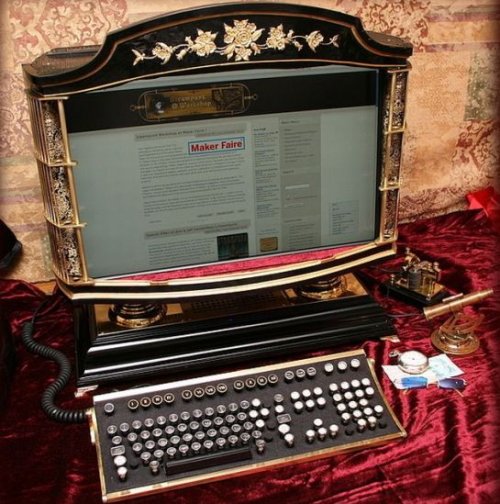
The other manifestation of the culture is making current or futuristic culture Victorian -- for example some artisans post step by step instructions for decorating computers to give them a steam-punk flair, or take pride in 'tin etching', and some fan artists draw pictures of Star Wars with Victorian technology.
http://www.slipperybrick.com/wp-content/uploads/2008/04/ain30-desktop-main_54.jpg

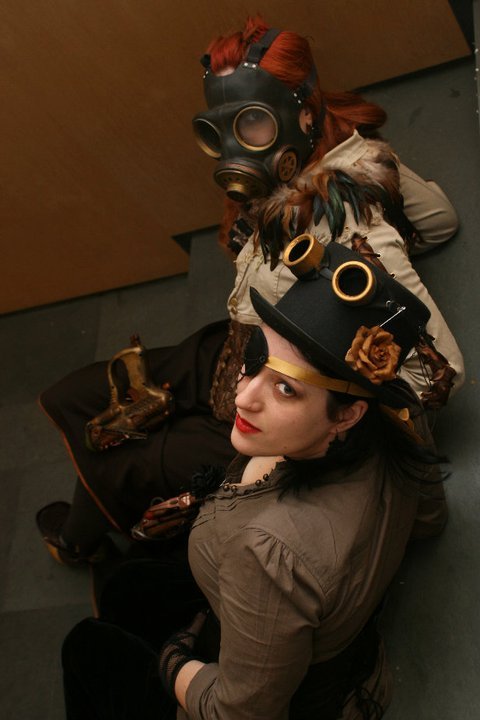
I believe this is an example of historicizing the cyborg.  By creating modernized technology out of something archaic, aren't we trying to render history into something undichotomized?  The differences between the Victorian era and today are vast, and Steampunk almost seems to be a way to help us familiarize ourselves with the future by associating it with the nostalgic past.  Other dichotomies are vanquished in this genre/sub-culture.  Many images depict women in shortened dresses or breeches, working alongside men with wrenches in steam powered dirigibles.  Perhaps this implies that technology has the ability to erase established gender boundaries the way it does today, when look at the world through the internet.
http://steampunk-beauties.tumblr.com/page/


The most popular fan accessory hands down seems to be the steam-punk goggles.  These are usually modeled as a cross between aviator goggles with jeweler's lens attached; the better to see the tiny clockwork gears that power the intricately designed Victorian era AI.  Now we look through computer screens to construct our programs, but perhaps with steam punk, Victorian era technology, goggles signify the same sort of power; the ability to see through the machine into the possibilities that it creates.  


http://amatoc.com/images/articles/steampunk/steampunk_goggles.jpg

Thursday, March 17, 2011

Boom Boom Pow: The Digital Afterlife.

I'm more a rock n' roll kind of gal, but every now and then I feel like doing my nerdy little head nod to something more techno.  So I remembered a song that went boom boom something, and looked it up.... and wham, came face to face with the cyborg.

Okay, so the lyrics "boom boom pow" aren't exactly deeply thought provoking, but the concept and the visuals most definitely are. The song itself is about music going digital... the opening scene of the music video is a listener selecting the song from a 'list' on a computer.  The singers constantly switch places with cyber singers and dancers, and in one scene Fergie has "monster hands" which to me signify the "monstrous" implications those unfamiliar with the cyborg may assume.  Will.i.am and Fergie actually spell out the concept of the cyborg in the "making of" video:


The concept of the singers and music being transported into the digital realm of the computer implies the formation of the cyborg... both the artists and the music become part of the technnology used to play the song.  In the "making of" interview clip above, there are several excellent statements made by the singers that signify that they have considered the implications.  Fergie speaks of the computer as a "digital afterlife"and describes how the album's title, E-N-D (Energy-Never-Dies) implies that once one is on the internet, one has created an identity that cannot be destroyed.  Will.i.am discusses how when music is digitized, there is no longer any seperation between the art and the music.


I find Fergie's concept of the "digital afterlife" interesting, since it is true that personalities created on the web will never die as long as there are servers to store them on.